The global glass curtain wall market is expected to be worth nearly USD 109.2 billion by 2034.
That figure isn’t just industry noise. It quietly reflects what’s already happening across cities and how buildings are getting lighter, more transparent, and far more performance-driven than they used to be.
Earlier, the issue was pretty clear. Buildings looked solid, but didn’t always feel comfortable inside. Heat built up over time, outside noise slipped in, and energy use kept climbing as towers grew taller and more dependent on mechanical cooling.
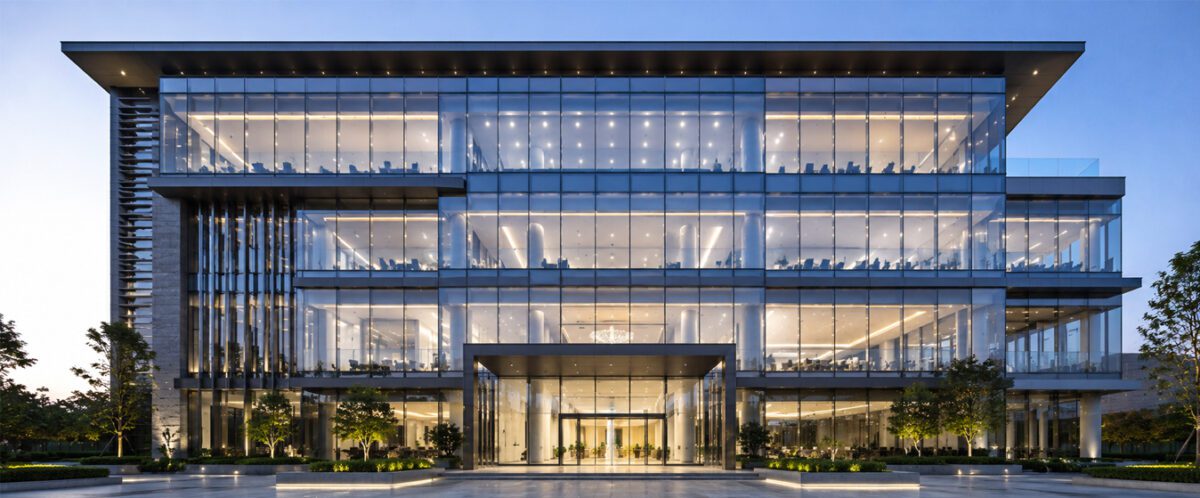
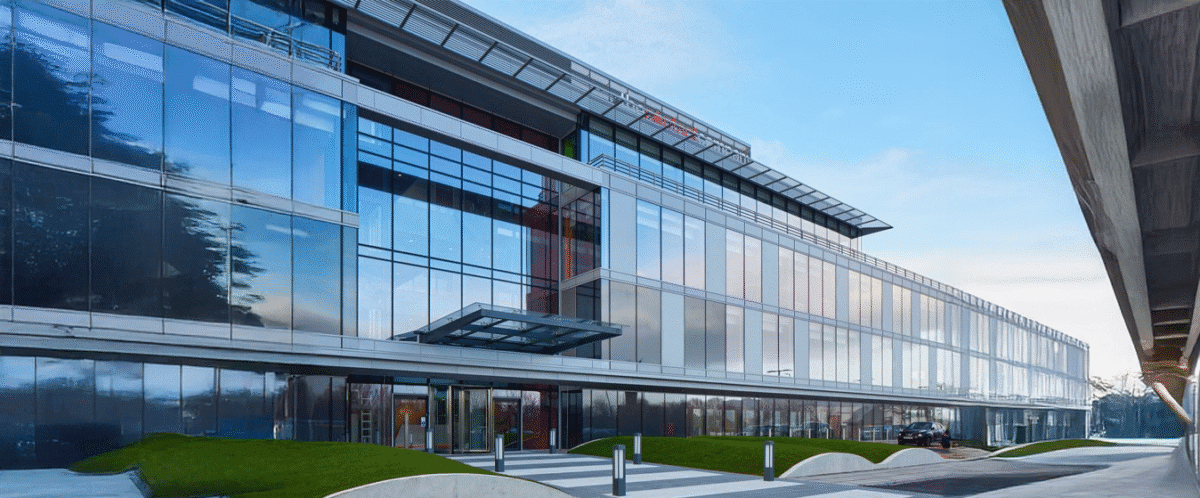
Curtain wall systems shifted that balance. They don’t take any structural load, yet they handle everything the exterior environment throws at a building, such as sun, wind, rain, and noise, while still allowing daylight to flow in and keeping the facade visually clean and lightweight.
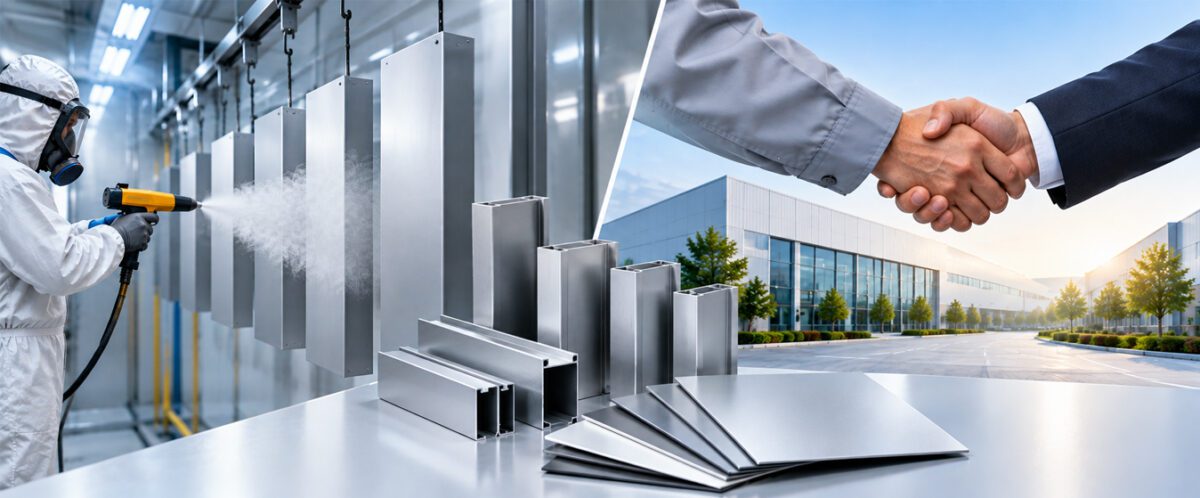
And here’s what often gets overlooked: the system alone doesn’t define performance. Execution does. The way it’s designed, fabricated, and installed is where curtain wall manufacturers make the real difference.
A curtain wall is basically the outer skin of a building that doesn’t support structural load. It’s fixed to the main frame and simply hangs from it, which is why the name makes sense.
Most systems use aluminium framing paired with glass panels. Some projects go with steel or composite sections, but aluminium remains the most common choice because it’s light, durable, and easy to work with.
Functionally, it does a lot more than it appears to do. It protects interiors from weather, controls heat gain, improves daylight inside, and also helps with sound insulation in busy urban areas.
So while it looks like just a facade, it behaves like a performance layer wrapped around the building, what many refer to as a glass curtain wall system.
Curtain walls don’t carry the building’s weight. Instead, they transfer wind pressure and seismic forces back to the structural frame through anchor points. It’s a controlled system, not a load-bearing one.
Modern systems use thermal break aluminium and advanced glazing like double or triple glass units. This helps reduce heat transfer and keeps indoor temperatures more stable, especially in extreme climates.
A good system doesn’t let air or water sneak in. That’s managed through proper gaskets, drainage channels, and pressure equalisation inside the system.
If designed and installed well, these systems last for decades. But even small errors in fabrication or sealing can reduce their life significantly.
Curtain walls come in different systems depending on how they are built and installed:
This is the traditional approach. Everything is assembled directly at the construction site.
Vertical members go up first, then horizontal sections, and finally, the glass is installed. It’s a step-by-step process.
The biggest advantage here is flexibility. If something needs adjusting mid-way, it can be done on-site without too much trouble.
But it takes time. A lot of it. And the final output depends heavily on the skill of the installation team.
It usually works better for mid-rise buildings or projects where design changes are expected during execution.
Here, panels are fully fabricated in a factory and then installed on-site.
Installation becomes faster and more predictable. Quality is consistent since production happens under controlled conditions.
This is why large projects often rely on experienced glass curtain wall manufacturers for unitized systems.
The trade-off? Limited flexibility once panels are produced.
This system sits somewhere between stick and unitized.
Some parts are prefabricated in the factory, while final assembly still happens on site. It’s a mix of both approaches.
It saves time compared to stick systems but still allows a bit of adjustment during installation.
It’s often used in mixed-use buildings where different sections of the project may have different design or execution needs.
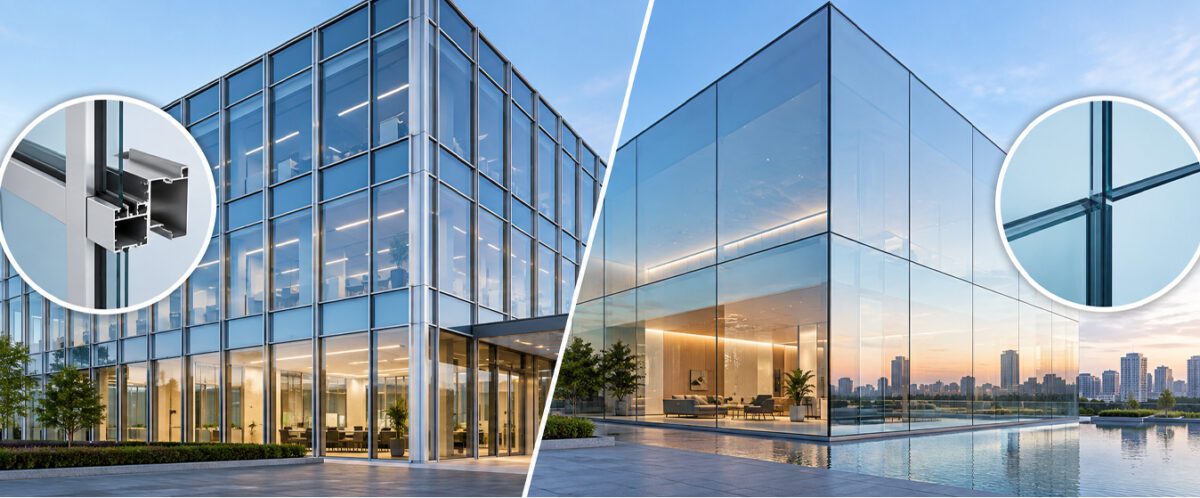
Here, glass takes centre stage. The framing is hidden, and the glass is bonded directly to the structure using silicone or structural adhesives.
The result is a smooth, uninterrupted glass surface.
It looks clean and modern, which is why it’s commonly used in corporate offices, showrooms, and premium retail buildings.
Light entry is high, and the facade feels almost continuous from the outside.
This approach does away with continuous aluminium frames altogether. Instead, glass panels are secured at specific points using stainless steel brackets or spider fittings.
The result feels noticeably lighter. There’s very little visual interruption, so the facade reads as open and transparent. You’ll usually spot this in entrance areas, atriums, or high-end commercial buildings where that sense of openness is intentional.
That said, it leaves very little room for error. Since loads transfer through individual fixing points, the engineering has to be exact.
In this system, a network of tensioned cables takes over the role of structural support. Glass panels are fixed onto this cable grid rather than a rigid frame.
What this allows is scale like large, uninterrupted glass surfaces without columns getting in the way. The facade almost behaves like a stretched surface, flexible but still capable of handling external loads.
It’s commonly used in airports, exhibition centres, and other large public buildings. Getting it right depends on tight coordination between structural and façade teams.
Vertical glass fins act as structural supports.
The result is a clean surface with defined vertical lines. Daylight penetrates deeper due to minimal obstruction.
Typically used in premium architectural projects.
This is the most commonly used and adaptable option. Aluminium sections form the primary framework, supporting different glazing configurations.
Its widespread use comes down to practicality. Aluminium is lightweight, resists corrosion, and performs reliably across different climates. It also works well with other system types, including unitized and structural glazing.
Because of that flexibility, it finds its place across everything, from commercial towers to residential developments and institutional buildings.
That’s why most glass curtain wall manufacturers prefer aluminium as the primary framework.
Instead of continuous frames, glass is held using point fixings. It creates a very open, transparent look.
Glass is supported by a tensioned cable network. This allows large open spans, often used in airports or big atrium spaces.
Vertical glass fins support the structure. It gives a very premium, architectural expression while keeping transparency high.
This remains the most widely used base system. It’s lightweight, weather-resistant, and adapts easily to different design needs and climates.
Curtain walls are everywhere now, but their use changes based on building type.
There’s no universal choice here. It always depends on the project.
| Parameter | What It Means | Why It Matters |
| U-Value | Heat transfer level | Impacts cooling and heating efficiency |
| Air Infiltration | Leakage through joints | Affects comfort and energy use |
| Water Resistance | Ability to block water | Critical in heavy rainfall conditions |
| Wind Load Resistance | Structural stability | Essential for tall buildings |
| Acoustic Performance | Noise control capacity | Important in urban environments |
| System Type | Speed | Flexibility | Cost Level | Best Use |
| Stick System | Slow | High | Low | Custom low-rise projects |
| Unitized System | Very fast | Moderate | Medium–High | High-rise buildings |
| Semi-Unitized | Moderate | High | Medium | Mixed-use developments |
| Structural Glazing | Moderate | Moderate | Medium-High | Premium facades |
| Point-Supported System | Moderate | Moderate | Higher side | Atriums, entrances, glass facades |
| Cable Net System | Moderate | Lower | High | Large-span public spaces |
| Glass Fin System | Moderate | Moderate | High | High-end architectural projects |
| Aluminium Systems | Flexible | High | Varies | Wide range of building types |
Curtain wall systems have reshaped modern buildings, moving beyond basic cladding to become performance-driven envelopes that influence comfort, energy use, and overall design identity.
Each system has a different purpose, like some suit fast-track construction, some allow design flexibility, while others are chosen for seamless visual appeal. The right choice always depends on the project’s requirements.
For projects that demand dependable facade engineering and well-executed curtain wall solutions, Aparna Externa brings focused expertise in delivering performance-led building envelope systems for modern architecture.
Q1. How long do curtain wall systems last?
Typically 25–50 years, depending on materials and maintenance.
Q2. Can curtain walls be installed on existing buildings
Yes, but only after structural evaluation and proper anchoring design.
Q3. Do curtain wall systems need regular maintenance?
Yes. Periodic cleaning and sealant checks are required for long-term performance.